How to choose a microphone for a video podcast
A treated room with a cheap dynamic mic beats a bare room with an expensive condenser, and it is not close. Here is how to choose once you accept that.
8 minute read

The default that goes wrong least often
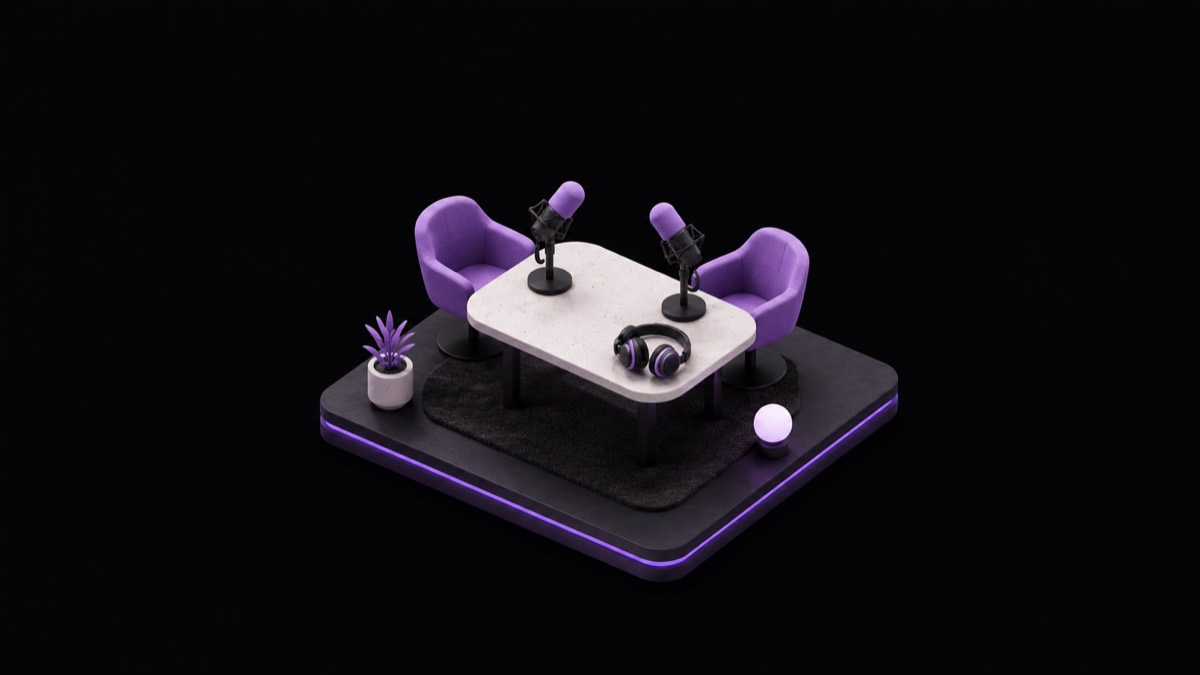
For a seated video podcast, the setup that fails least often is a cardioid dynamic microphone held within roughly a hand's width of your mouth, mounted on a boom arm or stand so it stays there, with one microphone per person recorded to its own track. That covers most rooms, most voices, and most budgets. Everything below is the reasoning behind that default, plus the specific situations where it changes — mainly when your room is genuinely quiet and acoustically treated, at which point a condenser becomes an option rather than a liability. The other thing worth saying immediately: if you have a fixed budget, moving money away from the microphone and toward the room is almost always the better trade.
Bad audio costs you credibility, not just polish
It is tempting to treat sound quality as a finishing touch. The evidence says it changes how you are judged. Eryn Newman at the Australian National University and Norbert Schwarz at the University of Southern California ran two experiments, published in Science Communication in 2018, in which people watched the same researcher deliver the same talk in either clear or degraded audio, and then in a second study heard interviews from NPR's Science Friday under the same manipulation. When the audio was worse, viewers rated the speaker as less intelligent and less likeable, judged the research itself less important, and were less willing to share it. Nothing about the content had changed. Nobody consciously grades your microphone; they grade you instead.
Your room decides more than your microphone does
What most people hear as cheap audio is not the capsule. It is their own voice leaving their mouth, bouncing off flat walls and a bare desk, and arriving at the microphone a few milliseconds late, which reads as hollow, distant and slightly boxy no matter what the microphone cost. Transom, the public-radio training project, is blunt about this in its voice-recording gear guide: room selection matters more than small differences in equipment, and poor acoustics cannot be fully compensated for by gear afterwards. So the honest ranking is room first, mic placement second, microphone third. If you have three hundred to spend, spending a third of it on the microphone and the rest on curtains, rugs and soft mass will sound better than the reverse.
Dynamic or condenser: the room answers this, not you
Condensers are more sensitive and have better high-frequency response, which is exactly why they are the wrong choice in an ordinary room — that sensitivity picks up the reflections, the fridge, and the street. Shure's own podcasting guidance notes that dynamics naturally mask sibilance and mouth noise that condensers reproduce faithfully, and Transom makes the complementary point that dynamics have tighter, more focused patterns that reduce the effect of a less-than-ideal room. So the rule is simple. Untreated room, shared space, or any background noise you cannot eliminate: dynamic. A quiet, treated room where you want detail and air in the voice: condenser is a genuine upgrade. Buying a condenser first and treating the room later is the standard expensive mistake.
USB or XLR, and the gain spec that catches people out
This decision is not really about sound quality, it is about how many voices you need to separate. Recording alone, a good USB microphone is completely sufficient and removes an entire category of setup problems. Two or more people in one room and you want XLR into an interface or field recorder that captures each speaker on their own track, because crosstalk on a shared track is the one problem editing cannot properly undo. Transom also warns that USB-only mics lock you out of mixers and field recorders later. Whichever route you take, check the gain figure: Shure's knowledge base states that a preamp used with the SM7 for voice-over work should have at least 60 dB of gain, and plenty of entry-level interfaces cannot deliver that cleanly. A low-output microphone on a noisy preamp is worse than an ordinary one on a decent preamp.
Cardioid nearly always, and what shotguns actually do
Shure's guidance is that cardioid is the sensible default because it is less sensitive to sound from the sides and rear, which cuts room noise and reflections, while tighter patterns like supercardioid and shotgun reject more but force you to hold your head in a much smaller area or your level visibly shifts. Shotguns also do not do what people think indoors. Bandrew Scott's comparison of a shotgun against a cardioid small-diaphragm condenser in ordinary rooms found only slight reverb reduction, noticeably worse off-axis colouration on the shotgun, and comb-filtering artefacts when speaking off-axis or near reflective surfaces. An interference tube rejects sound from specific angles; reverberation arrives from everywhere. It cannot fix a live room.
Lavalier, boom or a visible mic on the desk
For video the question becomes whether the microphone is allowed in frame. A lavalier's real advantage is not that it is hidden, it is that it keeps a constant short distance from your mouth however much you move, which stabilises level and beats the room; the costs are clothing rustle, cable management and a thinner sound than a good desk mic. A boomed mic just out of frame gives better tone but needs a stand, careful placement and a room that is not fighting you. And a visible mic on a desk or arm is a legitimate aesthetic — the podcast look exists precisely because putting the capsule close to the mouth is the single most effective thing you can do. Hiding the microphone almost always costs you signal-to-noise.
Placement, then the workflow around it
Shure suggests two to twelve inches as the working range, and the reason is arithmetic: closer makes your voice louder relative to the noise and reflections, which stay roughly where they were. Halve the distance and the direct sound climbs while the room does not. Expect proximity effect on a cardioid — a bass lift as you close in — and either back off slightly or engage a high-pass filter. Speak slightly across the capsule rather than straight into it, use a pop filter, and leave headroom on the meters. Then record each speaker to a separate track, because clean per-speaker audio is what makes everything downstream easy: editing, and pulling clips from the episode with a tool like FrameOS, both depend on it.
FAQ
What is the best microphone for a video podcast?
For most people, a cardioid dynamic microphone placed within a hand's width of the mouth, on a boom arm, with one mic per speaker on its own track. Dynamics reject room reflections and background noise far better than condensers, which is what most home recording spaces need. Move to a condenser only once the room is quiet and treated.
Do I need an XLR microphone or is USB good enough?
USB is genuinely fine for solo recording and removes several setup failure modes. Switch to XLR when two or more people record in the same room, because you need an interface or recorder that captures each speaker on a separate track. Crosstalk on a single shared track is the one problem editing cannot properly fix later.
Is a condenser mic better than a dynamic for podcasting?
Only in a treated room. Condensers are more sensitive with better high-frequency detail, which also means they capture reflections, air conditioning and street noise faithfully. Shure and Transom both point to dynamics for home setups because their lower sensitivity and tighter pattern mask room ambience and mouth noise.
Should I use a shotgun mic for talking-head video?
Rarely indoors. A shotgun's interference tube rejects certain angles, but reverberation arrives from every direction, so it does not remove room sound. Bandrew Scott's indoor comparison found worse off-axis colouration and comb filtering on a shotgun than on a cardioid condenser. If the mic must stay out of frame, a lavalier close to the mouth usually sounds better.
Sources
- Good Sound, Good Research: How Audio Quality Influences Perceptions of the Research and Researcher · Science Communication
- Choosing a Microphone for Podcasting · Shure
- Podcasting Basics, Part 1: Voice Recording Gear · Transom
- SM7B Output Level and Preamp Gain Specifications · Shure
- Should You Use Shotgun Microphones Indoors? · Bandrew Scott
Related pages
Keep reading
More Podcasts →How to use Twitter (X) in 2026
Most guides to this platform describe features that no longer exist. Communities shut down in May 2026, DMs became Chat, and the home screen now has more than two tabs.
9 minute readHow the X (Twitter) algorithm actually works
X is the only large platform that publishes the code ranking its main feed. It also had to add a comment to that code correcting the most-repeated claim about it.
9 minute readHow to use Pinterest: the setup, the formats and the search mindset
Pinterest reported 640 million monthly active users in its Q2 2026 results, and almost none of them are scrolling a friend feed — they are searching. That changes what you publish, how you title it, and how long it keeps working.
8 minute readTurn one long video into a week of posts
300 credits for 3 days · no card
Start free